

Discogs release pages with sales-history statistics can show three reference numbers — Lowest, Median, and Highest. The median is not a promise of what a specific record is worth.
Sometimes it is. Often it’s not even close.
The Discogs median price is a useful starting point, not a valuation promise. Here is how to use it without inventing precision the data cannot support.
What the Discogs Median Actually Measures
The displayed median summarizes historical marketplace transactions for a release. Discogs does not promise that your copy will sell at that number.
The problem is what goes into that calculation:
Condition changes comparability. A VG copy and a conservatively graded NM copy are different offers even when they share a release page.
Location and currency matter. Buyer location, seller location, shipping, and currency conversion affect the buyer’s total and the seller’s result.
Historical sales can lag current supply and demand. Compare the date and context of available transaction history with today’s competing inventory.
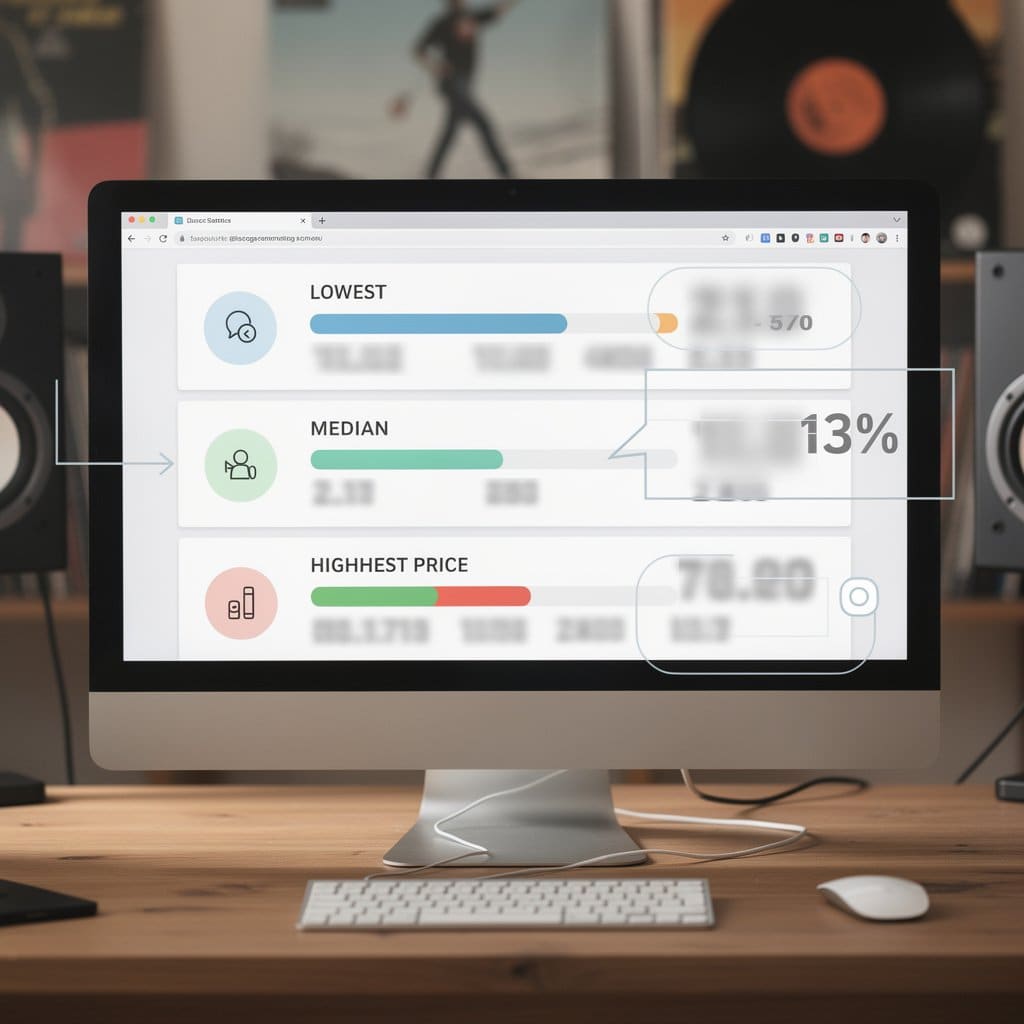
Three Illustrative Cases Where Median Can Mislead
Example 1: condition mismatch. If VG copies transact below clean NM copies, a combined reference point is not a substitute for condition-level comps.
Example 2: a changing market. A recent transaction can differ from older history after a reissue, artist event, or change in available supply.
Example 3: wrong release. Master-release context can contain many pressings. Price the exact catalog entry, identifiers, country, format, and variant.
How to Filter for Comparable Sales
The median is useless if you don’t understand the data behind it. Here’s how to get actual comparable prices:
Go to the specific release page. Not the master release — the exact pressing (identified by catalog number, label, and country). This narrows the data to your actual version.
Look at individual sold listings. Click through to the sales history and look at each sale. Note the condition grade and the price. Build your own picture of what copies like yours actually sell for.
Filter by condition mentally. Group the sales: what did NM copies sell for? VG+ copies? This is your real price guide for your specific condition grade.
Check the dates. Weight recent comparable transactions more heavily when supply or demand is changing. There is no universal three- or six-month cutoff; keep older observations as context and record the window you used.
Note geography and buyer total. Seller location, available destinations, shipping, duties, currency, and regional supply can change the buyer’s total. Use geographically comparable transactions when they are available.
When the Median Is Actually Useful
Despite its limitations, the median works well in certain situations:
Frequently traded titles with comparable grading. A larger set of recent, condition-comparable transactions makes a median more informative, but Discogs does not publish a threshold at which it becomes a reliable valuation.
Quick sanity checks. Before deeper research, the median is one reference point. A large gap between it and your intended price is a reason to inspect condition-comparable transactions and current supply, not proof that either price is correct.
Tracking changes over time. Recording the displayed statistics and available inventory at consistent intervals can reveal a change worth investigating. Price movement alone does not identify the cause; condition mix, exchange rates, outlier sales, and available supply can all move the reference point.

Building Your Own Price Intelligence
The most useful complement to marketplace history is your own sales data.
After selling a few hundred records, you build a personal database of what things actually sell for — from your store, with your grading, to your buyer base. This is far more relevant than the marketplace-wide median because it reflects your specific situation.
Track list price, accepted offer, grade, days to sell, shipping, fees, and return outcomes. Over time, those records show how your grading and buyer trust affect realized price without relying on an unverifiable anecdote.
The “Price Guide Is Not a Price Guarantee” Mindset
The Discogs median is a reference point, not a commitment. It summarizes the transactions included by Discogs; the public definition does not promise a fixed recent window or a future sale price for your copy.
Your price should be based on:
- Your specific pressing and condition
- Recent comparable sales (not the median)
- Current supply (how many other copies are for sale)
- Demand signals (wantlist count, your historical sell-through)
- Your minimum margin requirement
The sellers who consistently price well aren’t the ones who copy the median. They’re the ones who understand the data behind it, adjust for their specific situation, and track their own sales to build a personal pricing model.
That requires a real system—not just checking the Discogs page each time. Record what you paid, what you listed at, what sold, and what did not. Pair the pricing decision with the Discogs fee calculator so a higher sale price is evaluated as net profit rather than gross revenue.