
For Comic Book Sellers

Comic Book Inventory Software

Most of a comic inventory is worth a few dollars and a small part of it is worth most of the money, so the job is telling those apart reliably and repeatedly.

✓ Issue and variant detail✓ Raw and slabbed✓ Submission economics

THE SHAPE OF THE PROBLEM

The value is concentrated, and the concentration is not obvious from the pile.

A long box holds two hundred comics. Perhaps five of them matter financially — a first appearance, a low-print variant, a key issue that a recent adaptation has pulled into demand — and the rest are inventory you will move in bundles. The difficulty is that the five look exactly like the rest until you check the issue number, the printing and the cover variant.

Instica holds issue, variant, printing and grade as structured fields, so the concentration becomes visible in your own records instead of living in your memory. That also makes the grading question answerable: you can see what a book cost you before deciding whether the submission fee is worth spending on it.

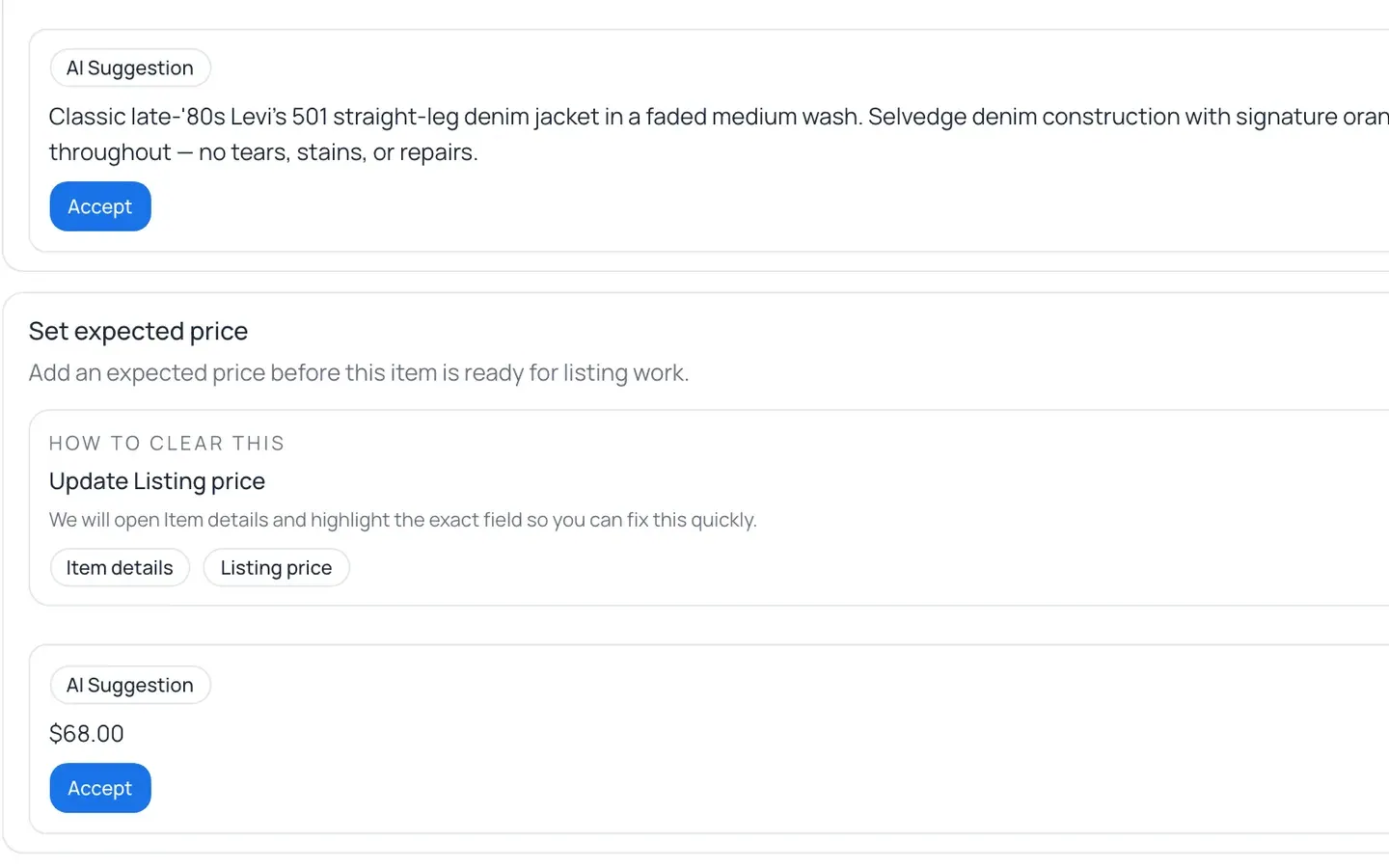
Instica listing draft with title, condition and price fields populated from the item record
A draft built from the record — issue, variant and printing carried through, so the listing cannot disagree with the inventory.

WHAT THE RECORD HOLDS

Three things worth getting right

Issue-level identity

Title, issue number, printing and cover variant together are what identify the book. Held separately they are searchable; buried in a listing title they are not, and variant confusion is the most common way a valuable book gets sold as a common one.

Raw and slabbed side by side

A graded book carries a grader, a numeric grade and a certification number. A raw book carries your own assessment. Keeping both in one system without conflating them lets you see your real exposure to grading outcomes.

Cost visible before you submit

Submission fees, shipping and insurance are a real investment per book. Seeing the acquisition cost on the record at the moment you make the submission decision is what keeps that decision rational.

THE WORKFLOW

Working through a collection buy

Comics are almost always acquired in bulk — a collection, a box lot, a shop clearance — and processed afterwards. The workflow is mostly about triage speed.

  1. 01

    Pull the keys first

    Go through for first appearances, notable variants and known key issues before doing anything else. Those are the books that justify individual records, photographs and careful grading time.

  2. 02

    Assign the collection cost by tier

    Weight the purchase price toward the keys rather than spreading it evenly. A collection bought for the two books that made it worth buying should show that in the numbers.

  3. 03

    Grade honestly and photograph the defects

    Spine ticks, corner wear, colour breaks and staple condition are what a buyer is assessing. Recording them at intake means the listing writes itself and the evidence exists if a grade is questioned.

  4. 04

    Decide slab or sell raw, then record the choice

    Marking the intended path keeps books that are waiting for submission out of your sellable stock, which is otherwise a common source of listing something you no longer physically have.

CHANNEL BY CHANNEL

The three channels, assessed for comics

Instica connects to eBay, Shopify and Discogs. For comics that is one strong fit, one situational fit, and one that does not apply.

eBay
The main market for both keys and slabbed books. Because eBay pushes sale notifications to Instica by webhook, a sold book is marked on the record and the rest of your listings are brought into line.
Shopify
Makes sense for shops and for sellers with a following who want fixed-price stock in one place. Instica publishes and updates quantity there, but does not read Shopify orders, so those sales are marked sold by you.
Discogs
Music releases only. It has nothing to offer a comics inventory, and we would rather say so than leave you to discover it after connecting.

WHERE IT GOES WRONG

Where comic sellers lose money

Missing the variant

Cover variants and later printings can differ enormously in value while looking near-identical on a shelf. A book sold at common-issue money because the printing was never recorded is a loss you never see, because from your side it just looked like a sale.

Submitting books that cannot clear the fee

Grading a book whose best realistic outcome barely exceeds the submission cost is a way of converting time and cash into a slab nobody wants. The check is whether the cost basis plus the fee leaves room, and that requires the basis to be recorded.

Grading generously

Optimistic raw grades produce returns and disputes, and in a market where reputation drives repeat buyers the second-order cost is larger than the first. Consistent, slightly conservative grading is cheaper.

FREQUENTLY ASKED

Questions comic sellers ask

Can I track books that are out for grading?

Yes. Keep the book as a record with its submission noted so it stays in your inventory but out of your sellable stock. When it comes back you update the same record with the grade and certification rather than starting a new one.

How do I handle bulk books I will sell in bundles?

Catalogue the bundle as the sellable unit rather than each issue individually. Cataloguing two hundred common books one at a time costs more time than the box is worth, and the record should match how you actually sell.

How many books can I list on the free plan?

Free covers 25 listings on a single channel. If you are cataloguing a whole collection, Operator at $19 a month raises that to 500 listings across all connected channels.

From the reselling course

Reading for a long box with three valuable books in it

Most of a comic inventory is worth a few dollars and a small part of it carries the money, so the work is separating the two reliably. These guides start there and follow the valuable end through grading, packing and risk.

  1. 01
    Valuing Inventory Before You Buy It

    Working a collection buy without pricing every book individually, and still finding the keys.

  2. 02
    Authentication and Counterfeit Risk

    Restoration, trimming and pressing: disclosed they are fine, undisclosed they end accounts.

  3. 03
    Grading and Describing Condition

    Spine ticks and colour breaks, in a defect list a buyer can verify on arrival.

  4. 04
    Packing Fragile and High-Value Items

    Bags, boards and a mailer that survives a sorting machine.

  5. 05
    Fraud, Scams, and Payment Risk

    The disputes that follow a four-figure key issue.

  6. 06
    Insurance and Business Risk

    Insuring a collection kept in a spare room, and what that phrase does to a policy.

Nothing gated — all 38 guides. To find your own constraint, try the three-minute diagnostic.

Start with 25 items. Stay for 25,000.

Free for 25 items · No card · Cancel from your account page.

También disponible en españolEspañol →
Disponível em portuguêsPortuguês →
Auf Deutsch verfügbarDeutsch →
Disponible en françaisFrançais →
中文版本可用中文 →