
One record, two sales routes
An item exists once whether it is sitting on your table or listed online. Marking it sold in one place is what keeps the other side from selling something you no longer have.
For Flea Market Sellers
Selling from a booth and selling online at the same time creates a specific problem: the same item can go two ways, and one of those ways leaves no digital trace at all.
THE SHAPE OF THE PROBLEM
If you sell at a market and online, half your transactions arrive as a note in a receipt book and a handful of notes in a cash box. Nothing pushes that into your inventory, which means the online listing for an item you sold on Sunday morning is still live on Sunday afternoon unless you go and remove it yourself.
Instica does not solve that automatically, and no software honestly can. What it does is keep one record per item so there is a single place to mark the booth sale, after which the connected channels are updated from that record. The habit still has to be yours; the reconciliation does not.
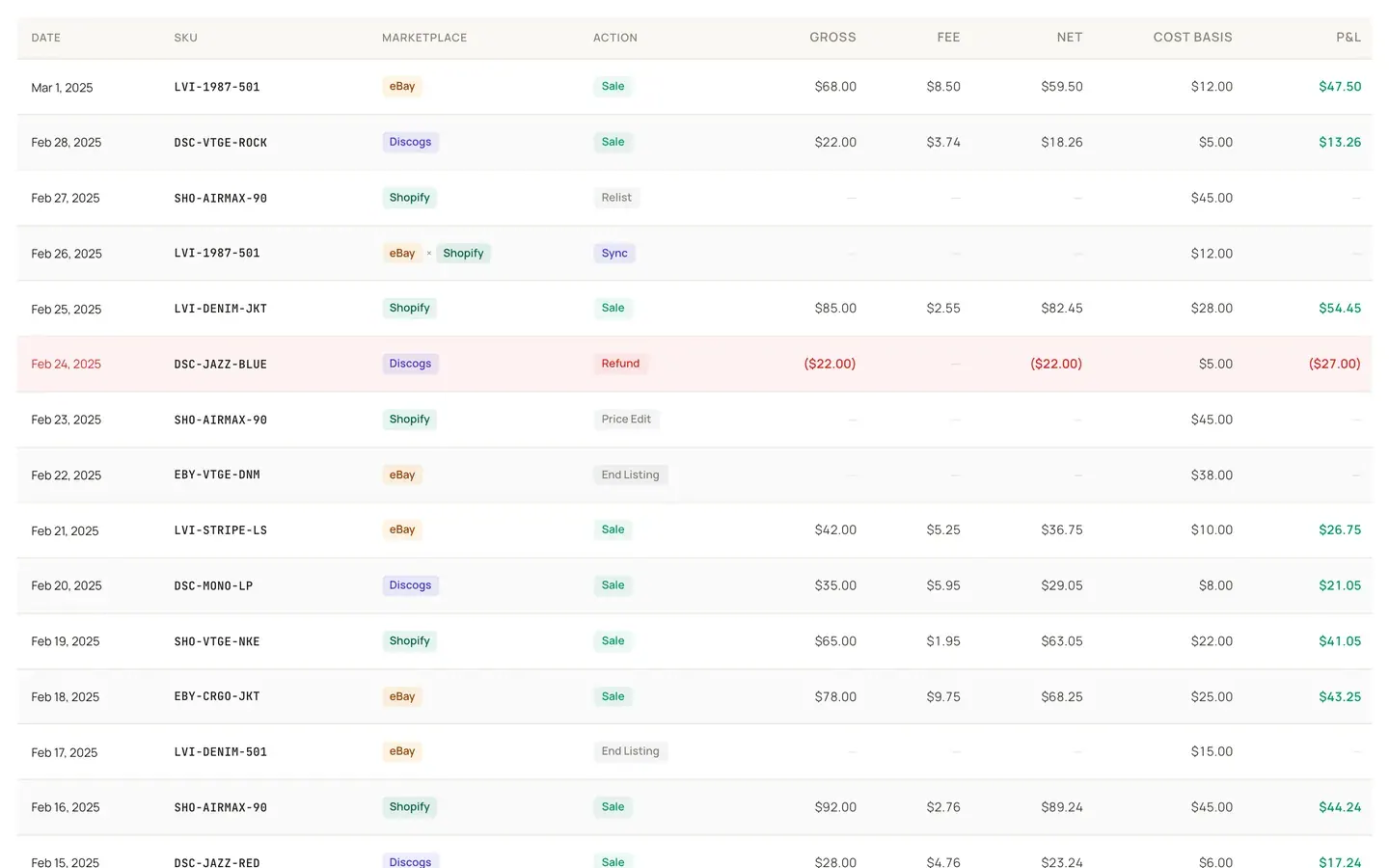
WHAT THE RECORD HOLDS
An item exists once whether it is sitting on your table or listed online. Marking it sold in one place is what keeps the other side from selling something you no longer have.
Market sourcing is cash, informal and receipt-free. Recording the cost while standing at the seller’s table is the only reliable moment, because there is no bank line or invoice to reconstruct it from later.
A photograph, a price and a cost is enough to create a record. If cataloguing takes longer than that in the field it will not happen, and a system nobody uses on a busy Saturday is not a system.
THE WORKFLOW
Flea market sellers are usually buying and selling in the same days, often at the same venue, which makes the paper trail the weakest part of the operation.
Cash changes hands and there is no record but yours. A photo and a number captured at the table is the entire basis for every profit figure you will produce for that item.
Table lots and box buys need their cost distributed across the pieces you intend to sell separately. Doing it before the box gets tipped out at home is much easier than after.
Bulky, low-value and impulse items belong on the table; the specific and searchable ones do better listed. Recording the intent stops the same item being carried back and forth for months.
Mark what sold at the market before the day’s memory fades. This is the step that keeps online listings honest, and it is the one that gets skipped when it is left for the week.
CHANNEL BY CHANNEL
Instica connects to eBay, Shopify and Discogs. The booth itself is not a channel any software connects to, which shapes how this works.
WHERE IT GOES WRONG
It goes at the booth on Saturday and sells online on Sunday, and now you are refunding a buyer and taking the feedback hit. Same-day reconciliation is the only defence, because nothing will tell you about the cash sale.
Cash purchases with no receipt leave you estimating cost at tax time, and estimates made under time pressure are consistently wrong in the direction that costs you. Capture at the table is the fix.
Items that have been to eight markets are not going to sell at the ninth, but without a record of when they came in they are invisible among the fresh stock. Intake dates make the dead weight obvious.
FREQUENTLY ASKED
No, and no tool can — a cash sale at a table produces no signal. You mark it sold on the record, and Instica then updates the connected channels from that. The manual step is the booth side only.
Yes. Cost is a field you enter, with a photo if you want one. For cash sourcing that is the only record that will ever exist, which is why capturing it on the spot matters so much.
Free covers 25 listings on one channel, which suits testing the workflow. If most of your table is also listed online, Operator at $19 a month and 500 listings is the realistic tier.
From the reselling course
A booth sale and an online sale draw down the same shelf, and only one of them tells you it happened. The order below follows stock from the buy, through the weekend, and into what came home again.
What a piece has to be bought at to survive both table pricing and marketplace fees.
Getting the online half listed in the days between markets, rather than eventually.
Cleaning and staging a load once, so it works on the table and in a photograph.
The labelling that lets you reconcile a cash weekend against a digital shelf.
Booth rent is a fixed cost against variable takings. That arithmetic deserves an hour.
The crates that travel to every market and come back full.
Free, no account needed — the complete guide index. To work out which constraint is actually binding, try the three-minute diagnostic.
Free for 25 items · No card · Cancel from your account page.