
Stock that has not arrived yet
Ordered, shipped and delivered are different states, and the first two represent money already spent. Recording items on order keeps the pipeline countable instead of living across a dozen confirmation emails.
For Online Arbitrage Sellers
In online arbitrage you commit money weeks before the goods arrive, so the hardest inventory question is not what is on the shelf but what is in transit and what it actually cost once everything settled.
THE SHAPE OF THE PROBLEM
Buying online means a purchase is placed, then confirmed, then shipped, then delivered — and at any moment a portion of your working capital is sitting in that pipeline. Some of it will be cancelled by the retailer, some will arrive short, and some will arrive as a substitution you did not order. A system that only knows about goods you have physically received is blind to the part of the business that is actually at risk.
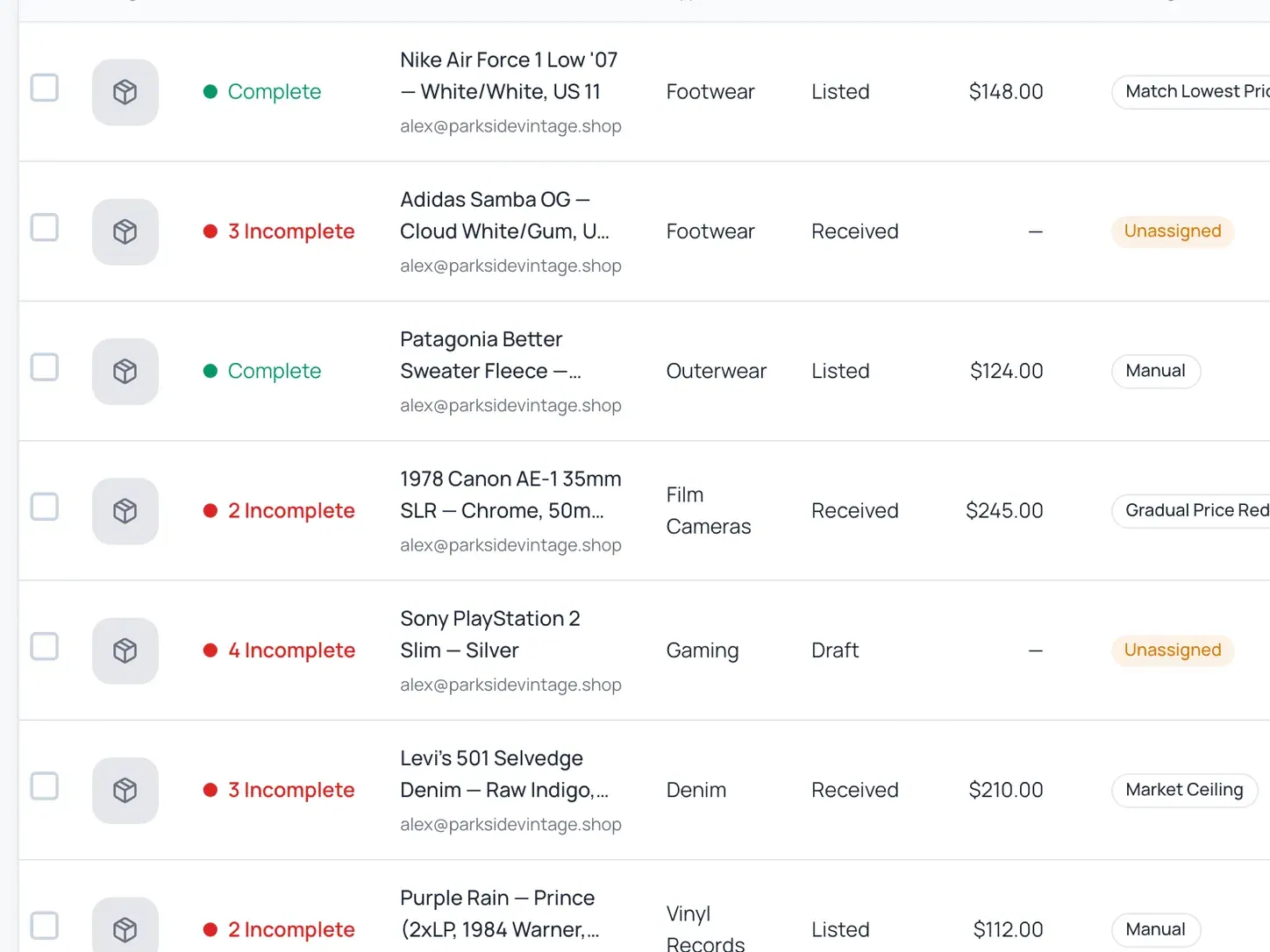
Instica lets you create records before delivery, so committed capital is visible while it is still in transit. Combined with a landed cost that includes shipping and any rebate you actually received, that gives you the two numbers this model runs on: what is coming, and what it truly cost.
WHAT THE RECORD HOLDS
Ordered, shipped and delivered are different states, and the first two represent money already spent. Recording items on order keeps the pipeline countable instead of living across a dozen confirmation emails.
Item price, shipping, tax, and any cashback or portal rebate that actually paid out. Rebates arrive weeks later and frequently do not arrive at all, so the honest cost is the one recorded after settlement, not at checkout.
Recording where each order came from turns cancellations, short shipments and substitutions into a pattern you can act on. Some sources cancel a tenth of what you order, and that is a cost as real as any fee.
THE WORKFLOW
Online arbitrage runs on a delay between commitment and possession, and most of the avoidable losses in this model happen inside that gap.
Create the records at purchase, not at delivery. Between those two events the money is gone and the goods are theoretical, and that is exactly the window worth being able to see.
Retailers cancel lines, substitute variants and ship short without much warning. Reconciling what arrived against what was ordered is where the discrepancies get caught while a claim is still possible.
Cashback and portal rebates take weeks and sometimes fail. Updating landed cost once they have actually paid is what keeps margin from being quietly overstated across your whole catalogue.
Returns-grade goods, damaged packaging and wrong variants all turn up. Checking against the order at unpack is cheaper than discovering it after a customer does.
CHANNEL BY CHANNEL
Instica connects to eBay, Shopify and Discogs. Online arbitrage is frequently run on platforms outside that list, so this is worth checking before you invest setup time.
WHERE IT GOES WRONG
A deal that only works with a rebate is a deal that fails when the rebate is denied, and denial rates are not small. Treating expected rebates as realised cost is the most common way this model produces phantom margin.
Orders across many retailers, arriving over weeks, in boxes that do not identify themselves. Without records created at purchase, short shipments and cancellations go unnoticed until the claim window has closed.
Buying on a card and selling before the statement is due feels like it is working right up to the month the sales slow. Knowing the value of committed, undelivered stock is what tells you how exposed you actually are.
FREQUENTLY ASKED
Yes, and for this model you should. Records created at the point of purchase are what make committed capital visible and give you something to reconcile the delivery against.
Adjust the landed cost once the rebate has actually paid out. Recording it at checkout assumes an outcome that does not always happen, and the resulting margin figures will be wrong in the optimistic direction.
It connects to eBay, Shopify and Discogs only. If you sell primarily elsewhere, Instica can still act as your cost and inventory ledger, but listing and quantity updates will not reach that platform.
From the reselling course
Online arbitrage commits money weeks before anything arrives, so most of your inventory is a purchase order rather than a shelf. These guides start at the buy decision and end at the stock that never moved.
Landed cost, not the invoice line, is the number a buy has to clear.
Deliveries land in clusters. Listing has to absorb a cluster without leaving a backlog.
Receiving properly: checking against the order before anything reaches a shelf.
In transit, received and listed are three states, and the record has to hold all three.
Money committed weeks ahead of the goods is the defining risk of this model.
A sourcing decision made six weeks ago can only be corrected on the shelf.
Free to read in any order — every guide in the course. Not sure which constraint binds first? Work through the three-minute diagnostic.
Free for 25 items · No card · Cancel from your account page.